class Animal:
    def __init__(self, name, age):
        self.name = name
        self.age = age

    def __repr__(self):
        return self.name

    @classmethod
    def from_dict(cls, d):
        return cls(**d)

class Ship:
    def __init__(self, name, mass):
        self.name = name
        self.mass = mass

    def __repr__(self):
        return self.name

    @classmethod
    def from_dict(cls, d):
return cls(**d)Design Patterns II
From ABC to Protocols
Introduction
In Design Patterns I, we explored the Gang of Four patterns and learned that many classic patterns are either obsolete in Python or already built into the language. We studied patterns like Factory, Composite, and Builder—understanding when to use them and when simpler Python idioms suffice.
Today we’re shifting gears. Instead of focusing on specific named patterns, we’ll explore three powerful concepts that fall under the broad umbrella of “design patterns”:
- Mixins: Sharing functionality across unrelated classes
- Abstract Base Classes (ABCs): Enforcing contracts while providing shared implementation
- Protocols: Defining interfaces without requiring inheritance
These aren’t traditional GoF patterns, but they’re essential tools in modern Python for creating extensible, maintainable code.
What’s the Goal?
By the end of this lecture, you’ll use these concepts to implement the Game of Trust—a variant of the Prisoner’s Dilemma where different strategies compete against each other. You’ll design a system where new player strategies can be easily added and plugged into a game engine.
We won’t hand you the solution on a silver platter. Instead, we’ll guide you through the design process with hints and examples.
Mixins
Sometimes you want to add the same functionality to multiple unrelated classes without duplicating code. That’s where mixins come in.
The Problem: Duplicate Code
Let’s say you’re building a system with different types of objects:
Notice the duplication? Both classes have identical from_dict methods. If we had 10 classes, we’d repeat this code 10 times. Tedious and error-prone!
Let’s test them:
waf = Animal('Onzen Blakkie', 2)
boot = Ship('Ana', 2000)

print(waf)
print(boot)
Onzen Blakkie
AnaAnd using the from_dict method:
waf_dict = {'name': 'Blakkie 2', 'age': 3}
Animal.from_dict(waf_dict)
Blakkie 2The Solution: Mixin Classes
A mixin is a class that provides methods intended to be added to other classes via inheritance. The key characteristic: mixins don’t stand on their own—they’re designed to be mixed in.
class FromDictMixin:
    @classmethod
    def from_dict(cls, d):
        return cls(**d)

class Animal(FromDictMixin):
    def __init__(self, name, age):
        self.name = name
        self.age = age

    def __repr__(self):
        return self.name

class Ship(FromDictMixin):
    def __init__(self, name, mass):
        self.name = name
        self.mass = mass

    def __repr__(self):
        return self.name
Now both classes inherit the functionality without duplicating code:
waf_dict = {'name': 'Blakkie 2', 'age': 3}
ship_dict = {'name': 'Titanic', 'mass': 52310}

print(Animal.from_dict(waf_dict))
print(Ship.from_dict(ship_dict))
Blakkie 2
TitanicA More Interesting Example: PrintMixin
Let’s create a mixin that adds printing functionality to any container-like class. Here’s a first approach:
class PrintMixin:
    def print(self):
        object_container = self._container
        for obj in object_container:
            print(obj)

class Info(PrintMixin):
    def __init__(self, messages, priority):
        self.messages = messages
        self.priority = priority

    @property
    def _container(self):
        return self.messages

class People(PrintMixin):
    def __init__(self, data, nr):
        self.nr = nr
        self.data = data

    @property
    def _container(self):
        return self.data
The mixin expects each class to provide a _container property. Let’s test it:
people = People(['Alice', 'Bob', 'Charlie'], 3)
people.print()
Alice
Bob
Charlieinfo = Info(['System starting', 'Loading config', 'Ready'], priority=1)
info.print()System starting
Loading config
ReadyThis works, but there’s a more Pythonic way! Instead of requiring a _container property, we can make the mixin work with any iterable class:
class PrintMixin:
    def print(self):
        for obj in self:
            print(obj)

class Info(PrintMixin):
    def __init__(self, messages, priority):
        self.messages = messages
        self.priority = priority

    def __iter__(self):
        return iter(self.messages)

class People(PrintMixin):
    def __init__(self, data, nr):
        self.nr = nr
        self.data = data

    def __iter__(self):
        return iter(self.data)
Now the mixin is simpler and the classes are more Pythonic—they support iteration:
info = Info(['Today', 'no', 'class'], priority=-1)
info.print()
Today
no
class# Bonus: since we implemented __iter__, we can use them in for loops!
for message in info:
print(f"Message: {message}")Message: Today
Message: no
Message: class
Mixin Naming Convention
By convention, mixin class names often end with “Mixin” (e.g., FromDictMixin, PrintMixin). This makes it clear they’re intended to be mixed in with other classes, not used standalone.
Mixins vs. Regular Inheritance
Use mixins when:
- You want to share orthogonal functionality
- Multiple unrelated classes need the same utility methods
- There’s no “is-a” relationship between the classes
Use regular inheritance when:
- There’s a true “is-a” relationship (Dog is an Animal)
- You’re building a class hierarchy with shared state
- Subclasses extend or specialize the parent’s behavior
Abstract Base Classes (ABCs)
Abstract Base Classes provide a way to define interfaces when you want to enforce that certain methods must be implemented by subclasses, while also providing some shared functionality.
The Core Idea
The key insight with ABCs is this split of responsibilities:
- Library author: Provides partial implementation and defines which methods are required
- Library user: Must implement the abstract methods
- At runtime: The library’s concrete methods can safely call the abstract methods, knowing they’ll exist
This is different from regular inheritance (where the parent provides everything) and protocols (where the parent provides nothing).
Example: A Bank Account System
Let’s build a bank account system where we provide transaction processing, but let users implement the actual deposit/withdraw logic:
from abc import ABC, abstractmethod

class BalanceInsufficient(Exception):
    pass

class BankAccount(ABC):
    """Base class for bank accounts. Subclasses must implement deposit and withdraw."""

    def __init__(self):
        self._state = 0

    @abstractmethod
    def deposit(self, amount):
        """Add money to the account. Must be implemented by subclasses."""
        pass

    @abstractmethod
    def withdraw(self, amount):
        """Remove money from the account. Must be implemented by subclasses."""
        pass

    def process_transactions(self, transactions):
        """Process a list of transactions. Provided by the ABC."""
        for kind, amount in transactions:
            if kind == 'deposit':
                self.deposit(amount)
            elif kind == 'withdraw':
                self.withdraw(amount)
            else:
                raise Exception(f"Invalid transaction kind {kind}")

    def can_afford(self, amount):
        """Check if the account has sufficient funds. Provided by the ABC."""
        return self._state >= amount
Notice what we’ve done:
deposit()andwithdraw()are abstract methods: subclasses must implement themprocess_transactions()andcan_afford()are concrete methods: they’re provided for free- The concrete methods safely use the abstract ones
Now let’s implement two different account types:
class MyBankAccount(BankAccount):
    """A responsible bank account that prevents overdrafts."""

    def deposit(self, amount):
        self._state += amount

    def withdraw(self, amount):
        if self.can_afford(amount):
            self._state -= amount
        else:
            raise BalanceInsufficient("Balance not sufficient, transaction cancelled")

class Alameda(BankAccount):
    """A... creative accounting system. When you run out of money, just add more! 🎰"""

    def deposit(self, amount):
        self._state += amount

    def withdraw(self, amount):
        self._state -= amount
        if self._state < 0:
            # Oops, we're negative. Let's just... fix that.
            self._state = 1000  # Customer funds? What customer funds?
Let’s test them:
account = MyBankAccount()
transactions = [
    ('deposit', 300),
    ('deposit', 1000),
    ('withdraw', 800),
]

account.process_transactions(transactions)
print(f"Balance: {account._state}")
Balance: 500What if we try to overdraw?
account = MyBankAccount()
transactions = [
    ('deposit', 300),
    ('withdraw', 800)  # Trying to withdraw more than we have!
]

account.process_transactions(transactions)
--------------------------------------------------------------------------- BalanceInsufficient Traceback (most recent call last) Cell In[15], line 7 1 account = MyBankAccount() 2 transactions = [ 3 ('deposit', 300), 4 ('withdraw', 800) # Trying to withdraw more than we have! 5 ] ----> 7 account.process_transactions(transactions) Cell In[12], line 28, in BankAccount.process_transactions(self, transactions) 26 self.deposit(amount) 27 elif kind == 'withdraw': ---> 28 self.withdraw(amount) 29 else: 30 raise Exception(f"Invalid transaction kind {kind}") Cell In[13], line 11, in MyBankAccount.withdraw(self, amount) 9 self._state -= amount 10 else: ---> 11 raise BalanceInsufficient("Balance not sufficient, transaction cancelled") BalanceInsufficient: Balance not sufficient, transaction cancelled
The Alameda account, on the other hand, has… different rules:
account = Alameda()
transactions = [
    ('deposit', 100),
    ('withdraw', 200),  # More than we have!
]

account.process_transactions(transactions)
print(f"Alameda balance: {account._state}")  # Magically 1000! 🎩✨
Alameda balance: 1000
Why ABCs Are Useful
The power here is separation of concerns:
- The ABC author (you, in this case) handles the complex logic of processing transactions
- The ABC user just needs to implement the basic operations
- Everyone benefits from having the complex logic written once and tested thoroughly
This is particularly useful in frameworks and libraries where you want users to plug in custom behavior.
What If You Don’t Implement Abstract Methods?
Python won’t let you instantiate a class that doesn’t implement all abstract methods:
class BrokenAccount(BankAccount):
    def deposit(self, amount):
        self._state += amount
    # Oops, forgot to implement withdraw!

account = BrokenAccount()  # This will fail!
--------------------------------------------------------------------------- TypeError Traceback (most recent call last) Cell In[17], line 6 3 self._state += amount 4 # Oops, forgot to implement withdraw! ----> 6 account = BrokenAccount() # This will fail! TypeError: Can't instantiate abstract class BrokenAccount without an implementation for abstract method 'withdraw'
The error happens at instantiation time, not when you try to call the missing method. This is a form of early error detection. A decent type checker will even discover the error before running the code.
Real-World Example: collections.abc
Python’s standard library uses ABCs extensively in collections.abc. These define interfaces for various collection types.
For example, collections.abc.Mapping is the ABC for dictionary-like objects. To implement a complete mapping, you only need to provide three methods:
import collections.abc

# Let's see what we need to implement:
print("Abstract methods:", collections.abc.Mapping.__abstractmethods__)
Abstract methods: frozenset({'__len__', '__getitem__', '__iter__'})Everything else comes for free! Let’s build a case-insensitive mapping:
class CaseInsensitiveMapping(collections.abc.Mapping):
    """A dictionary that treats keys as case-insensitive."""

    def __init__(self, **kwargs):
        # Store everything with lowercase keys internally
        self._data = {key.lower(): value for key, value in kwargs.items()}

    def __getitem__(self, key):
        return self._data[key.lower()]

    def __iter__(self):
        return iter(self._data)

    def __len__(self):
        return len(self._data)
Now watch the magic—we get lots of methods for free:
mapping = CaseInsensitiveMapping(Name="Alice", Age="30", City="Brussels")

# Access with any case:
print(mapping["name"])
print(mapping["NAME"])
print(mapping["NaMe"])

# We get these methods for free:
print("Keys:", list(mapping.keys()))
print("Values:", list(mapping.values()))
print("Items:", list(mapping.items()))
print("'city' in mapping:", 'city' in mapping)
print("'CITY' in mapping:", 'CITY' in mapping)
Alice
Alice
Alice
Keys: ['name', 'age', 'city']
Values: ['Alice', '30', 'Brussels']
Items: [('name', 'Alice'), ('age', '30'), ('city', 'Brussels')]
'city' in mapping: True
'CITY' in mapping: TrueWe implemented three methods and got keys(), values(), items(), get(), __contains__, and more—all for free!
Explore collections.abc
The collections.abc module contains ABCs for: - Iterable, Iterator - Sequence, MutableSequence (list-like) - Set, MutableSet - Mapping, MutableMapping (dict-like) - And many more!
Check the documentation to see what you need to implement vs. what you get for free.
Protocols
Protocols represent a different approach to defining interfaces: structural subtyping, also known as “static duck typing.”
The Core Idea
With protocols, we define what methods a class should have, but classes don’t need to explicitly inherit from the protocol. If a class has the right methods, it “implements” the protocol automatically.
This is the formal version of Python’s duck typing philosophy: “If it walks like a duck and quacks like a duck, it’s a duck.”
From ABCs to Protocols
Let’s contrast ABCs and Protocols with an example. Here’s a Protocol:
from typing import Protocol

class Printable(Protocol):
    """Any object with a print() method that returns a string."""
    def print(self) -> str:
        ...
Now we can create classes that implement this protocol without inheriting from it:
class Knight:
    def __init__(self, name):
        self.name = name

    def print(self) -> str:
        return f'I am Sir {self.name}, knight of the realm! ⚔️'

class Priest:
    def __init__(self, name):
        self.name = name

    def print(self) -> str:
        return f'I am Father {self.name}, servant of the faith. 🙏'

class Wizard:
    def __init__(self, name):
        self.name = name

    def print(self) -> str:
        return f'I am {self.name} the Wise, master of arcane arts! 🔮'
Notice: none of these classes inherit from Printable, but they all have a print() method that returns a string. They implicitly implement the protocol!
Type Checking with Protocols
Protocols are primarily for static type checkers (like mypy or Pylance). We can write functions that accept any Printable:
def announce(character: Printable) -> None:
    """Announce a character. Works with anything that has print()."""
    message = character.print()
    print(f"📢 {message}")

# All of these work:
announce(Knight("Lancelot"))
announce(Priest("Benedict"))
announce(Wizard("Gandalf"))
📢 I am Sir Lancelot, knight of the realm! ⚔️
📢 I am Father Benedict, servant of the faith. 🙏
📢 I am Gandalf the Wise, master of arcane arts! 🔮The type checker will verify that each argument has a print() method. But if we pass something without the right method:
class Goblin:
    def __init__(self, name):
        self.name = name
    # No print() method!

# This will type-check fail (but might run anyway):
# announce(Goblin("Griznak"))  # ❌ Type checker error
Protocols and Runtime Checking
By default, you cannot use isinstance() with protocols:
knight = Knight("Galahad")
isinstance(knight, Printable)  # ❌ This fails!
--------------------------------------------------------------------------- TypeError Traceback (most recent call last) Cell In[25], line 2 1 knight = Knight("Galahad") ----> 2 isinstance(knight, Printable) # ❌ This fails! File ~/.local/share/uv/python/cpython-3.13.5-linux-x86_64-gnu/lib/python3.13/typing.py:2117, in _ProtocolMeta.__instancecheck__(cls, instance) 2111 return _abc_instancecheck(cls, instance) 2113 if ( 2114 not getattr(cls, '_is_runtime_protocol', False) and 2115 not _allow_reckless_class_checks() 2116 ): -> 2117 raise TypeError("Instance and class checks can only be used with" 2118 " @runtime_checkable protocols") 2120 if _abc_instancecheck(cls, instance): 2121 return True TypeError: Instance and class checks can only be used with @runtime_checkable protocols
If you need runtime checking, you must make the protocol @runtime_checkable:
from typing import Protocol, runtime_checkable

@runtime_checkable
class PrintableRuntime(Protocol):
    def print(self) -> str:
        ...

knight = Knight("Galahad")
print(isinstance(knight, PrintableRuntime)) # ✅ Now it works!TrueHowever, runtime checking is rarely needed. Protocols are mainly for static type checkers.
A More Practical Example
Let’s define a protocol for drawable objects in a game:
from typing import Protocol

class Drawable(Protocol):
    """Objects that can be drawn to the screen."""

    def get_position(self) -> tuple[int, int]:
        """Return the (x, y) position."""
        ...

    def get_sprite(self) -> str:
        """Return a string representation (simplified; normally an image)."""
        ...

    def draw(self) -> None:
        """Draw the object."""
        ...
Now we can implement various drawable objects:
class Player:
    def __init__(self, x, y, name):
        self.x = x
        self.y = y
        self.name = name

    def get_position(self) -> tuple[int, int]:
        return (self.x, self.y)

    def get_sprite(self) -> str:
        return "🧙"

    def draw(self) -> None:
        pos = self.get_position()
        sprite = self.get_sprite()
        print(f"{sprite} at ({pos[0]}, {pos[1]})")

class Tree:
    def __init__(self, x, y):
        self.x = x
        self.y = y

    def get_position(self) -> tuple[int, int]:
        return (self.x, self.y)

    def get_sprite(self) -> str:
        return "🌲"

    def draw(self) -> None:
        pos = self.get_position()
        print(f"{self.get_sprite()} at ({pos[0]}, {pos[1]})")

class Coin:
    def __init__(self, x, y, value):
        self.x = x
        self.y = y
        self.value = value

    def get_position(self) -> tuple[int, int]:
        return (self.x, self.y)

    def get_sprite(self) -> str:
        return "🪙"

    def draw(self) -> None:
        x, y = self.get_position()
        print(f"{self.get_sprite()} ({self.value} gold) at ({x}, {y})")
Now we can write rendering functions that work with any drawable:
def render_all(drawables: list[Drawable]) -> None:
    """Render all drawable objects."""
    for obj in drawables:
        obj.draw()

# Create a scene:
scene = [
    Player(10, 20, "Hero"),
    Tree(15, 20),
    Tree(15, 25),
    Coin(12, 22, 50),
    Coin(14, 18, 100)
]

render_all(scene)
🧙 at (10, 20)
🌲 at (15, 20)
🌲 at (15, 25)
🪙 (50 gold) at (12, 22)
🪙 (100 gold) at (14, 18)The type checker verifies that every object in scene implements the Drawable protocol!
ABCs vs. Protocols: When to Use What
Both ABCs and Protocols define interfaces, but they serve different purposes. Let’s compare them directly.
The Key Difference
| Aspect | Abstract Base Classes | Protocols |
|---|---|---|
| Inheritance required? | Yes, must inherit explicitly | No, just implement the methods |
| Provides implementation? | Yes, can provide concrete methods | No, purely interface definition |
| Enforcement | Runtime (can’t instantiate without implementing) | Compile-time (type checker only) |
Use isinstance()? |
Yes, naturally | Only with @runtime_checkable |
| Best for | Library authors providing functionality | Defining pure interfaces |
When to Use ABCs
Use Abstract Base Classes when:
✅ You’re providing shared functionality
class BaseProcessor(ABC):
    @abstractmethod
    def process(self, data):
        pass

    def run(self, data_list):  # ← Shared implementation
        return [self.process(d) for d in data_list]
✅ You want runtime enforcement
# Can't instantiate without implementing abstract methods
processor = BaseProcessor()  # ❌ Fails immediately
✅ You’re working with inheritance hierarchies
class Animal(ABC):
    @abstractmethod
    def make_sound(self): pass

    def breathe(self):  # All animals breathe the same way
        print("*inhale* *exhale*")
✅ You need isinstance() checks
if isinstance(obj, collections.abc.Mapping):
    # It's dict-like, we can use it safely
    ...
When to Use Protocols
Use Protocols when:
✅ You’re defining a pure interface (no shared implementation)
class Comparable(Protocol):
    def compare(self, other) -> int: ...
✅ You don’t control the classes being used
# Third-party classes can satisfy your protocol
# without changing their code
✅ You want structural subtyping (“duck typing”)
# If it has the right methods, it works!
def sort_items(items: list[Comparable]): ...
✅ You’re focused on type checking
# Mainly for static analysis tools
def process(data: Serializable) -> None: ...
Example: The Same Interface, Two Ways
Here’s how you’d implement the same concept with both approaches:
With ABC:
from abc import ABC, abstractmethod

class LoggerABC(ABC):
    @abstractmethod
    def log(self, message: str) -> None:
        pass

    def log_error(self, message: str) -> None:  # Provided by ABC
        self.log(f"ERROR: {message}")

class FileLogger(LoggerABC):  # Must inherit
    def log(self, message: str) -> None:
        print(f"[FILE] {message}")

logger = FileLogger()
logger.log_error("Something went wrong")  # Uses the provided method
[FILE] ERROR: Something went wrongWith Protocol:
from typing import Protocol

class LoggerProtocol(Protocol):
    def log(self, message: str) -> None: ...

class ConsoleLogger:  # No inheritance!
    def log(self, message: str) -> None:
        print(f"[CONSOLE] {message}")

def log_error(logger: LoggerProtocol, message: str) -> None:
    logger.log(f"ERROR: {message}")

logger = ConsoleLogger()
log_error(logger, "Something went wrong")  # Type checks!
[CONSOLE] ERROR: Something went wrongNotice:
- The ABC provides
log_error()as a convenience method - The Protocol just defines the interface; helper functions are separate
Rule of Thumb
- If you’re writing a library and want to provide utilities → ABC
- If you’re writing a library and just need a contract → Protocol
- If you’re writing application code with type hints → Protocol
- If you need both, you can use them together! (Advanced topic for another day)
The Game of Trust: A Design Challenge
Now it’s time to apply what you’ve learned! We’ll design a system for the Game of Trust, a fascinating variant of the Prisoner’s Dilemma.
What is the Game of Trust?
The Game of Trust is based on the Prisoner’s Dilemma, one of the most famous problems in game theory. Here’s how it works:
The Rules:
- Two players face each other repeatedly
- Each round, both players simultaneously choose: Cooperate or Cheat
- The payoff depends on both choices:
- Both cooperate: Each gets 2 points ✨
- Both cheat: Each gets 1 point 😐
- One cooperates, one cheats: Cheater gets 3 points, cooperator gets 0 points 😢
The Dilemma:
- If you cooperate and your opponent cheats, you get nothing
- But if everyone always cheats, everyone loses in the long run
- Trust and cooperation lead to better outcomes, but they’re risky!
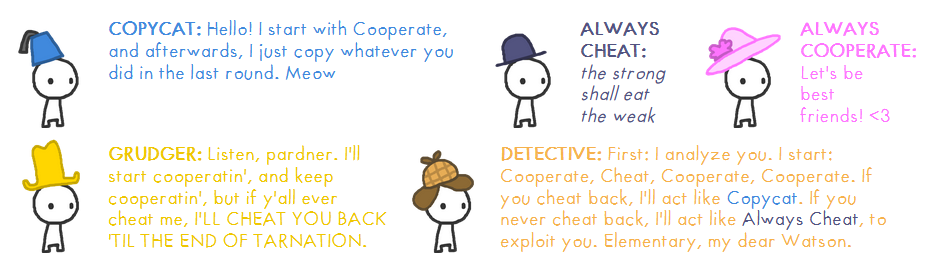
Here are some classic strategies:
- Always Cooperate: Trusting to a fault 😇
- Always Cheat: Ruthless and selfish 😈
- Copycat: Starts cooperative, then mimics opponent’s last move 🐈
- Grudger: Cooperates until cheated once, then always cheats forever 😠
- Detective: Tests the opponent first, then adapts 🕵️
For more background, check out this excellent interactive explanation or this video.
The Challenge
Your task is to design a system where:
- New player strategies can be easily implemented
- A game engine can pit any two players against each other
- The engine tracks history and calculates scores
- Extension: A tournament system that runs all strategies against each other
The key design question: Should you use an ABC or a Protocol?
Try It Yourself First!
Before looking at the hints below, spend 10-15 minutes thinking about the design:
- What methods should all players have?
- What information does a player need to make a decision?
- Should you provide shared functionality or just define an interface?
- How should the Game class work?
Sketch out a design on paper or in comments. Then use the hints to refine your solution.
Hint 0: The high level structure
What classes will be required at a high perspective?
There is going to be:
- a class named
GameorGameMasterwhich organizes rounds. - classes
AlwaysCheats,Detective, … for each player type.
How will these classes cooperate at the highest level? Start by thinking about the Game class.
Hint 1: The Game Class
Let’s think about the high level structure of the game first.
- Accept two players
- Run a specified number of rounds
- Get moves from both players
- Inform the players of the outcome
- Calculate and return scores
Structure:
class Game:
    def __init__(self, player1, player2, rounds=10):
        ...

    def play(self):
        # For each round:
        #   - Get moves from both players
        #   - Calculate points
        #   - Store history
        # Return final scores
        ...
Payoff calculation:
from typing import Literal

Move = Literal['cooperate', 'cheat']

def calculate_payoff(move1: Move, move2: Move):
    match (move1, move2):
        case ('cooperate', 'cooperate'):
            return (2, 2)
        case ('cheat', 'cooperate'):
            return (3, 0)
        case ('cooperate', 'cheat'):
            return (0, 3)
        case ('cheat', 'cheat'):
            return (0, 0)
        case _:
            raise RuntimeError
Hint 2a: The Player Interface
All player strategies need to make decisions. When do they need to make decisions? When do they receive new information?
There are essentially two time a player interacts with the game per round:
- Once, at the start, when they need to make a decision.
- Second, at the end of the round, when they are informed of their opponents decision.
Hint 2b: ABC or Protocol?
Ask yourself the key questions from earlier:
Do you need to provide shared functionality? - Could be useful: a helper method like opponent_cooperated_last_round() - But most logic is strategy-specific
Will players inherit from your class? - If using ABC: Yes, they must inherit - If using Protocol: No, just implement the methods
Do you need runtime checking? - Probably not critical for this application
Recommendation: Either could work! - ABC if you want to provide helper methods - Protocol if you want more decoupling
For the solution below, we’ll use an ABC to demonstrate that approach. Feel free to try a Protocol instead!
Hint 3: The Player class
Let’s put this idea in code:
from abc import ABC, abstractmethod

class Player(ABC):
    def __init__(self, name):
        self.name = name
        # Subclasses might store arbitrary state here
        pass

    @abstractmethod
    def next_move(self):
        pass

    @abstractmethod
    def opponent_move(self, move: Move):
        # Investigate the opponents move
        # The players can update their state to influence their
        # next decision.
        pass
Hint 4: Simple Strategies
Let’s implement the simplest strategies in this framework:
Always Cooperate:
class AlwaysCooperate(Player):
    def next_move(self) -> Move:
        return 'cooperate'

    def opponent_move(self, move: Move):
        pass  # Doesn't care what opponent does
Always Cheat:
class AlwaysCheat(Player):
    def next_move(self) -> Move:
        return 'cheat'

    def opponent_move(self, move: Move):
        pass  # Doesn't care what opponent does
Copycat (slightly harder - needs to remember last opponent move):
class Copycat(Player):
    def __init__(self, name):
        super().__init__(name)
        self.last_opponent_move = 'cooperate'  # Start assuming cooperation

    def next_move(self) -> Move:
        return self.last_opponent_move

    def opponent_move(self, move: Move):
        self.last_opponent_move = move  # Remember for next round
Now try implementing Grudger and Detective yourself!
Starter Code: Minimal Framework
Here’s a minimal framework to get you started. Try implementing the missing parts yourself!
from abc import ABC, abstractmethod
from typing import Literal

Move = Literal['cooperate', 'cheat']

class Player(ABC):
    """Base class for all player strategies."""

    def __init__(self, name: str):
        self.name = name

    @abstractmethod
    def next_move(self) -> Move:
        """Return the next move for this player."""
        pass

    @abstractmethod
    def opponent_move(self, move: Move):
        """Process the opponent's move from the last round."""
        pass

    def __repr__(self):
        return f"{self.__class__.__name__}('{self.name}')"


class Game:
    """Runs a game between two players."""

    def __init__(self, player1: Player, player2: Player, rounds: int = 10):
        self.player1 = player1
        self.player2 = player2
        self.rounds = rounds
        self.score1 = 0
        self.score2 = 0

    def calculate_payoff(self, move1: Move, move2: Move) -> tuple[int, int]:
        """Calculate points for both players based on their moves."""
        match (move1, move2):
            case ('cooperate', 'cooperate'):
                return (2, 2)
            case ('cheat', 'cooperate'):
                return (3, 0)
            case ('cooperate', 'cheat'):
                return (0, 3)
            case ('cheat', 'cheat'):
                return (1, 1)

    def play_round(self):
        """Play a single round."""
        # TODO: Get moves from both players using next_move()
        # TODO: Calculate payoff
        # TODO: Inform both players of opponent's move using opponent_move()
        # TODO: Update scores
        pass

    def play(self) -> tuple[int, int]:
        """Play all rounds and return final scores."""
        for _ in range(self.rounds):
            self.play_round()
        return (self.score1, self.score2)

    def print_summary(self):
        """Print game results."""
        print(f"\n{'='*50}")
        print(f"{self.player1.name} vs {self.player2.name}")
        print(f"Rounds: {self.rounds}")
        print(f"Final Score: {self.score1} - {self.score2}")
        if self.score1 > self.score2:
            print(f"🏆 Winner: {self.player1.name}!")
        elif self.score2 > self.score1:
            print(f"🏆 Winner: {self.player2.name}!")
        else:
            print("🤝 It's a tie!")
        print(f"{'='*50}\n")


# TODO: Implement your strategies here!
class AlwaysCooperate(Player):
    def next_move(self) -> Move:
        # TODO: implement
        pass

    def opponent_move(self, move: Move):
        # TODO: implement
        pass

class AlwaysCheat(Player):
    def next_move(self) -> Move:
        # TODO: implement
        pass

    def opponent_move(self, move: Move):
        # TODO: implement
        pass

class Copycat(Player):
    def __init__(self, name):
        super().__init__(name)
        # TODO: What state do you need to track?

    def next_move(self) -> Move:
        # TODO: implement
        pass

    def opponent_move(self, move: Move):
        # TODO: implement
        pass

# Test your implementation:
# game = Game(AlwaysCooperate("Nice"), AlwaysCheat("Mean"), rounds=5)
# game.play()
# game.print_summary()
Complete Solution: Working Implementation
Here’s a complete working implementation with multiple strategies. Study this after you’ve tried it yourself!
from abc import ABC, abstractmethod
from typing import Literal

Move = Literal['cooperate', 'cheat']

class Player(ABC):
    """Base class for all player strategies in the Game of Trust."""

    def __init__(self, name: str):
        self.name = name

    @abstractmethod
    def next_move(self) -> Move:
        """Decide next move. Called at the start of each round."""
        pass

    @abstractmethod
    def opponent_move(self, move: Move):
        """Process opponent's move. Called at the end of each round."""
        pass

    def __repr__(self):
        return f"{self.__class__.__name__}('{self.name}')"


class AlwaysCooperate(Player):
    """Always cooperates, no matter what. The eternal optimist! 😇"""

    def next_move(self) -> Move:
        return 'cooperate'

    def opponent_move(self, move: Move):
        pass  # Doesn't care what opponent does


class AlwaysCheat(Player):
    """Always cheats, no matter what. Pure selfishness! 😈"""

    def next_move(self) -> Move:
        return 'cheat'

    def opponent_move(self, move: Move):
        pass  # Doesn't care what opponent does


class Copycat(Player):
    """
    Starts by cooperating, then copies opponent's last move.
    Also known as Tit-for-Tat. Simple but surprisingly effective! 🐈
    """

    def __init__(self, name):
        super().__init__(name)
        self.last_opponent_move: Move = 'cooperate'  # Start nice

    def next_move(self) -> Move:
        return self.last_opponent_move

    def opponent_move(self, move: Move):
        self.last_opponent_move = move  # Remember for next round


class Grudger(Player):
    """
    Cooperates until cheated once, then cheats forever.
    Holds a grudge like you wouldn't believe! 😠
    """

    def __init__(self, name):
        super().__init__(name)
        self.been_cheated = False

    def next_move(self) -> Move:
        if self.been_cheated:
            return 'cheat'
        return 'cooperate'

    def opponent_move(self, move: Move):
        if move == 'cheat':
            self.been_cheated = True  # Never forgive!


class Detective(Player):
    """
    Starts with: Cooperate, Cheat, Cooperate, Cooperate.
    If opponent never retaliates, always cheat.
    Otherwise, play Copycat. Clever and adaptive! 🕵️
    """

    def __init__(self, name):
        super().__init__(name)
        self.round_num = 0
        self.opponent_ever_cheated = False
        self.last_opponent_move: Move = 'cooperate'

    def next_move(self) -> Move:
        # First 4 moves: Test pattern
        if self.round_num == 0:
            return 'cooperate'
        elif self.round_num == 1:
            return 'cheat'  # Sneak in a cheat!
        elif self.round_num == 2:
            return 'cooperate'
        elif self.round_num == 3:
            return 'cooperate'

        # After testing: Did they ever retaliate?
        if not self.opponent_ever_cheated:
            # They never fought back! Take advantage forever
            return 'cheat'
        else:
            # They fought back, so play nice (Copycat strategy)
            return self.last_opponent_move

    def opponent_move(self, move: Move):
        if move == 'cheat':
            self.opponent_ever_cheated = True
        self.last_opponent_move = move
        self.round_num += 1


class Game:
    """Manages a game between two players."""

    def __init__(self, player1: Player, player2: Player, rounds: int = 10):
        self.player1 = player1
        self.player2 = player2
        self.rounds = rounds
        self.score1 = 0
        self.score2 = 0

    def calculate_payoff(self, move1: Move, move2: Move) -> tuple[int, int]:
        """Calculate points based on both players' moves."""
        match (move1, move2):
            case ('cooperate', 'cooperate'):
                return (2, 2)
            case ('cheat', 'cooperate'):
                return (3, 0)
            case ('cooperate', 'cheat'):
                return (0, 3)
            case ('cheat', 'cheat'):
                return (1, 1)

    def play_round(self):
        """Play a single round of the game."""
        # Get moves from both players (simultaneously)
        move1 = self.player1.next_move()
        move2 = self.player2.next_move()

        # Calculate payoff
        points1, points2 = self.calculate_payoff(move1, move2)

        # Update scores
        self.score1 += points1
        self.score2 += points2

        # Inform players of opponent's move
        self.player1.opponent_move(move2)
        self.player2.opponent_move(move1)

    def play(self) -> tuple[int, int]:
        """Play all rounds and return final scores."""
        for _ in range(self.rounds):
            self.play_round()
        return (self.score1, self.score2)

    def print_summary(self):
        """Print a summary of the game results."""
        print(f"\n{'='*60}")
        print(f"Game: {self.player1.name} vs {self.player2.name}")
        print(f"Rounds: {self.rounds}")
        print(f"Final Score: {self.score1} - {self.score2}")

        if self.score1 > self.score2:
            print(f"🏆 Winner: {self.player1.name}!")
        elif self.score2 > self.score1:
            print(f"🏆 Winner: {self.player2.name}!")
        else:
            print("🤝 It's a tie!")

        print(f"{'='*60}\n")
Let’s test our implementation with various matchups:
# Nice vs Mean
game1 = Game(AlwaysCooperate("Nice Guy"), AlwaysCheat("Mean Guy"), rounds=5)
game1.play()
game1.print_summary()

# Copycat vs Mean
game2 = Game(Copycat("Copycat"), AlwaysCheat("Cheater"), rounds=5)
game2.play()
game2.print_summary()

# Copycat vs Nice
game3 = Game(Copycat("Copycat"), AlwaysCooperate("Nice Guy"), rounds=5)
game3.play()
game3.print_summary()

# Grudger vs Detective (interesting!)
game4 = Game(Grudger("Grudgy"), Detective("Detective"), rounds=10)
game4.play()
game4.print_summary()
============================================================
Game: Nice Guy vs Mean Guy
Rounds: 5
Final Score: 0 - 15
🏆 Winner: Mean Guy!
============================================================


============================================================
Game: Copycat vs Cheater
Rounds: 5
Final Score: 4 - 7
🏆 Winner: Cheater!
============================================================


============================================================
Game: Copycat vs Nice Guy
Rounds: 5
Final Score: 10 - 10
🤝 It's a tie!
============================================================


============================================================
Game: Grudgy vs Detective
Rounds: 10
Final Score: 14 - 11
🏆 Winner: Grudgy!
============================================================
Notice how different strategies perform against each other!
Key design features:
- Players maintain their own state between rounds
- The
next_move()method is called to get decisions - The
opponent_move()method informs players what happened - The Game class orchestrates everything without knowing strategy details
Extension Challenge: Tournament System
Want to go further? Implement a tournament system that pits all strategies against each other:
class Tournament:
    ...
Other extensions to try:
- Add “noise” (random chance of mistake)
- Variable number of rounds (players don’t know when game ends)
- Three-player variant
- Visualize game history with matplotlib
- Add more sophisticated strategies
Reflection
Think about what you’ve built:
- The Player ABC defines the interface and provides a clean base for strategies
- Each strategy is self-contained and easy to understand
- The Game class handles all the complex orchestration
- Adding new strategies is as simple as creating a new class
This is the power of good design! You’ve separated concerns, made the system extensible, and created clean abstractions.
Additional Resources
- PEP 3119 – Introducing Abstract Base Classes
- PEP 544 – Protocols: Structural subtyping
- Python
abcmodule documentation - Python
typing.Protocoldocumentation - collections.abc – Abstract Base Classes for Containers
- Type Hints in Python – Real Python tutorial
If you enjoyed the Game of Trust, explore:
- Axelrod Python library – Run tournaments with 200+ strategies
- Robert Axelrod’s book “The Evolution of Cooperation”
- The Iterated Prisoner’s Dilemma
- The Evolution of Trust – Interactive game theory explanation
- Game Theory and the Prisoner’s Dilemma – Veritasium video
For more on design patterns in Python:
- Python Patterns Guide by Brandon Rhodes
- Design Patterns in Python – Refactoring Guru
- Python Design Patterns – GitHub repository with examples